Where Light Cannot Decide
A single ray goes into a crystal and a ring of light comes out. Hamilton predicted it in 1832 from mathematics alone — and the reason it has to happen is topological
Light in a crystal usually splits in two. The crystal offers it two speeds, each with its own polarization, and sends each polarization its own way. In 1832 William Rowan Hamilton noticed that along certain special directions the two speeds coincide, and that the crystal is then left with no way of choosing where to send the light. So it sends it every way at once, around a hollow cone, and a thin beam leaves the crystal as a ring. Within two months Humphrey Lloyd had seen the ring in a piece of aragonite. Here the prediction is built up from pictures, together with the detail Lloyd noticed next: going once around the cone, the light’s polarization turns only half a turn. That half is the key to the whole thing. It is why the special directions have to exist at all, and why, in a crystal with no special symmetry, they can only be cones.
1. One ray in, a ring out
Here is the experiment. Take a crystal of aragonite — a common mineral, the stuff mother-of-pearl is made of — and polish two parallel faces on it, cut at a particular angle to its internal structure. Shine a narrow beam of light through it and look at what comes out of the far side.
Tilt the crystal a little either way and you see two spots of light, which is what crystals do; more on that in a moment. But line the beam up with one particular direction inside the crystal, and the two spots swell, bend towards each other and close up into a single bright ring. One ray went in. A hollow cylinder of light came out.
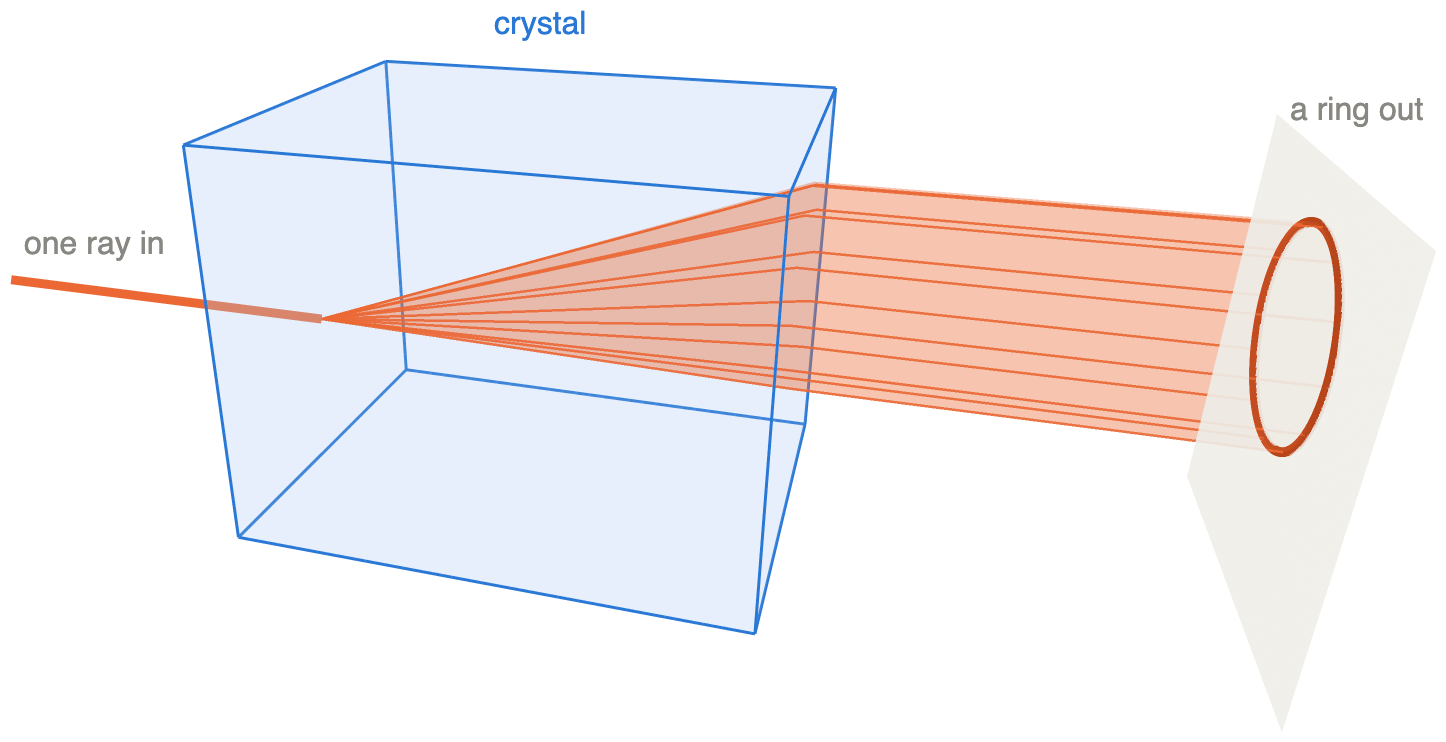
What makes this famous is not that it happens but the order in which things happened. William Rowan Hamilton — twenty-seven, and already Astronomer Royal of Ireland — predicted it in 1832 by studying the geometry of Augustin Fresnel’s theory of light in crystals. Nobody had seen anything like it. His colleague at Trinity College Dublin, Humphrey Lloyd, went looking, and within two months he had found it. Lloyd later described the moment the crystal came into line as “the sudden and almost magical change of the appearance, from two luminous points to a perfect luminous ring”, and the angle of the cone he measured agreed with Hamilton’s calculation to within five minutes of arc.
It was among the first times mathematics announced something in nature that nobody had yet seen, and it made both men’s reputations. The question here is why it happens — and, more interestingly, why it has to.
2. Two speeds for every direction
Start with what crystals ordinarily do. Put a clear rhomb of calcite on a printed page and you see every letter twice, a fact Rasmus Bartholin recorded in 1669. A ray entering the crystal comes out as two rays.
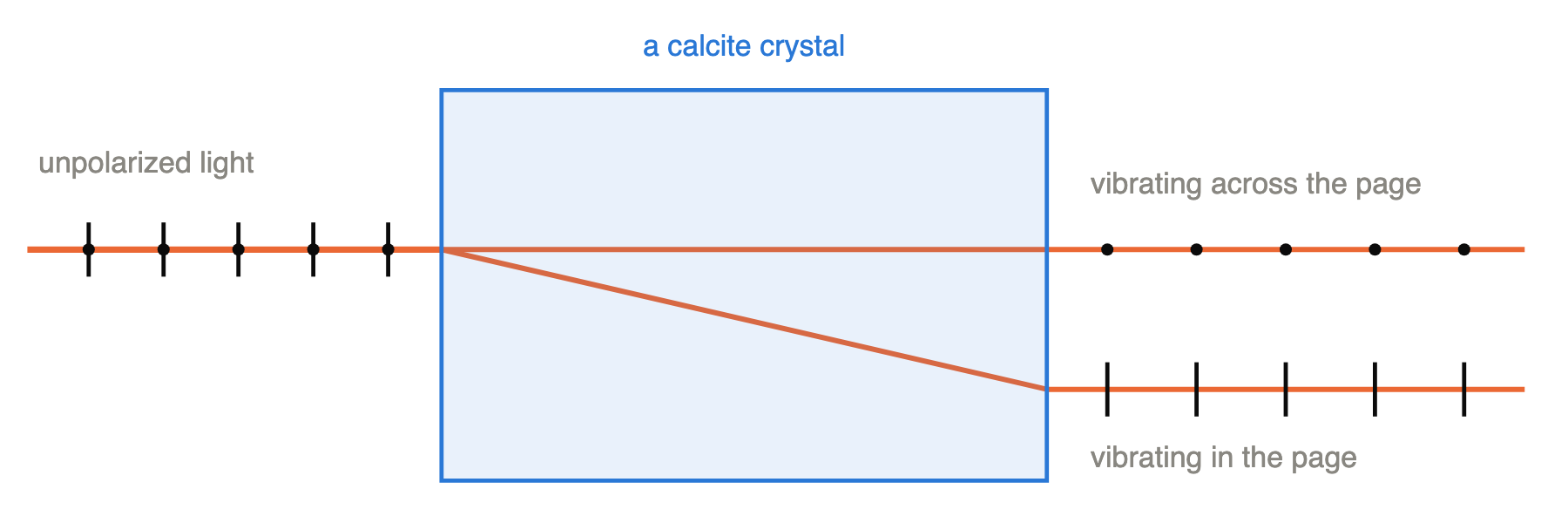
The reason is polarization. Light is a transverse wave — whatever vibrates, vibrates across the direction of travel — so for each direction of travel there is a whole plane of possible vibration directions. In glass or water it makes no difference which one you choose; all of them travel at the same speed. A crystal is different. Its atoms are stacked in a lattice that is easier to polarize one way than another, and for each direction of travel it singles out exactly two vibration directions, at right angles to each other, that pass through it unchanged, each at its own speed. Any other polarization is a mixture of those two, and the two part company.
The arithmetic behind this is the arithmetic of an ellipse. Each direction of travel \(\mathbf{s}\) comes with a symmetric \(2 \times 2\) matrix \(M(\mathbf{s})\) that acts on the plane of vibrations across \(\mathbf{s}\) and is built from the crystal’s three principal refractive indices and nothing else. The two waves are its eigenvectors:
\[ M(\mathbf{s})\,\mathbf{d} \;=\; \frac{1}{n^{2}}\,\mathbf{d} . \]Here \(\mathbf{d}\) is the polarization and \(n\) the refractive index, the factor by which that wave is slower than light in vacuum. A symmetric matrix has two eigenvectors, always at right angles, and two eigenvalues: two polarizations, two speeds. Everything in this article comes out of that one small matrix.
3. Drawing every speed at once
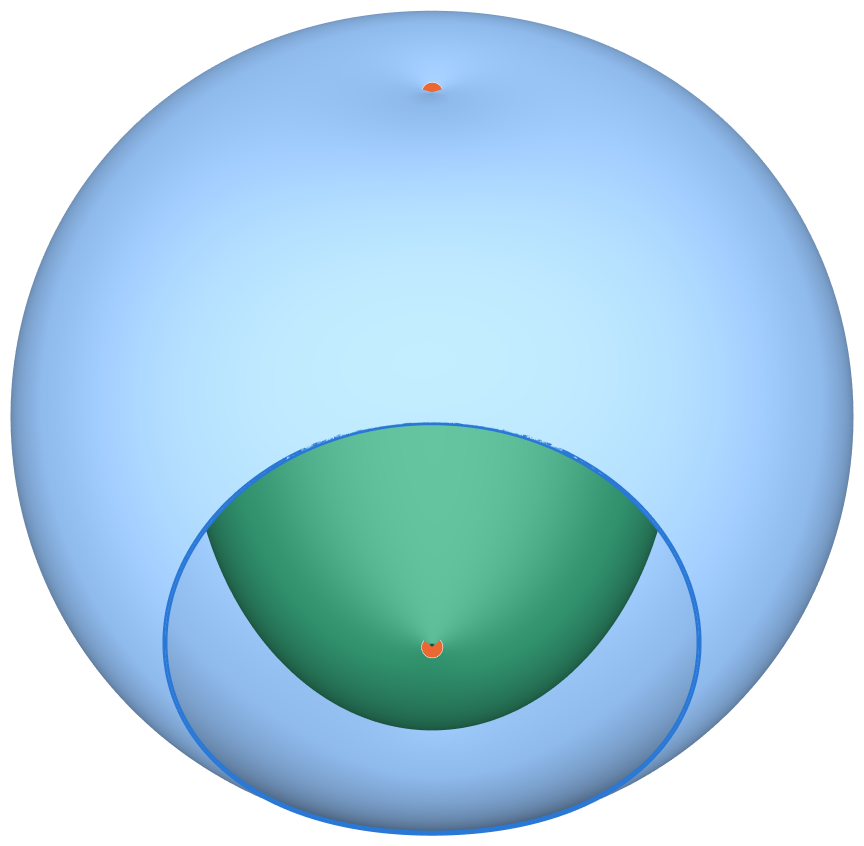
Aragonite has three different refractive indices along three perpendicular directions in the crystal — call them \(n_1 < n_2 < n_3\) — which makes it biaxial, for a reason about to appear. To see all of its speeds at once, draw a surface: in every direction from a centre point, mark two points, at distances equal to the two refractive indices for that direction. The result is called the index surface, and it has two sheets, one nested inside the other.
Sliced through the plane that contains the largest and the smallest index, it is simple enough to draw exactly.
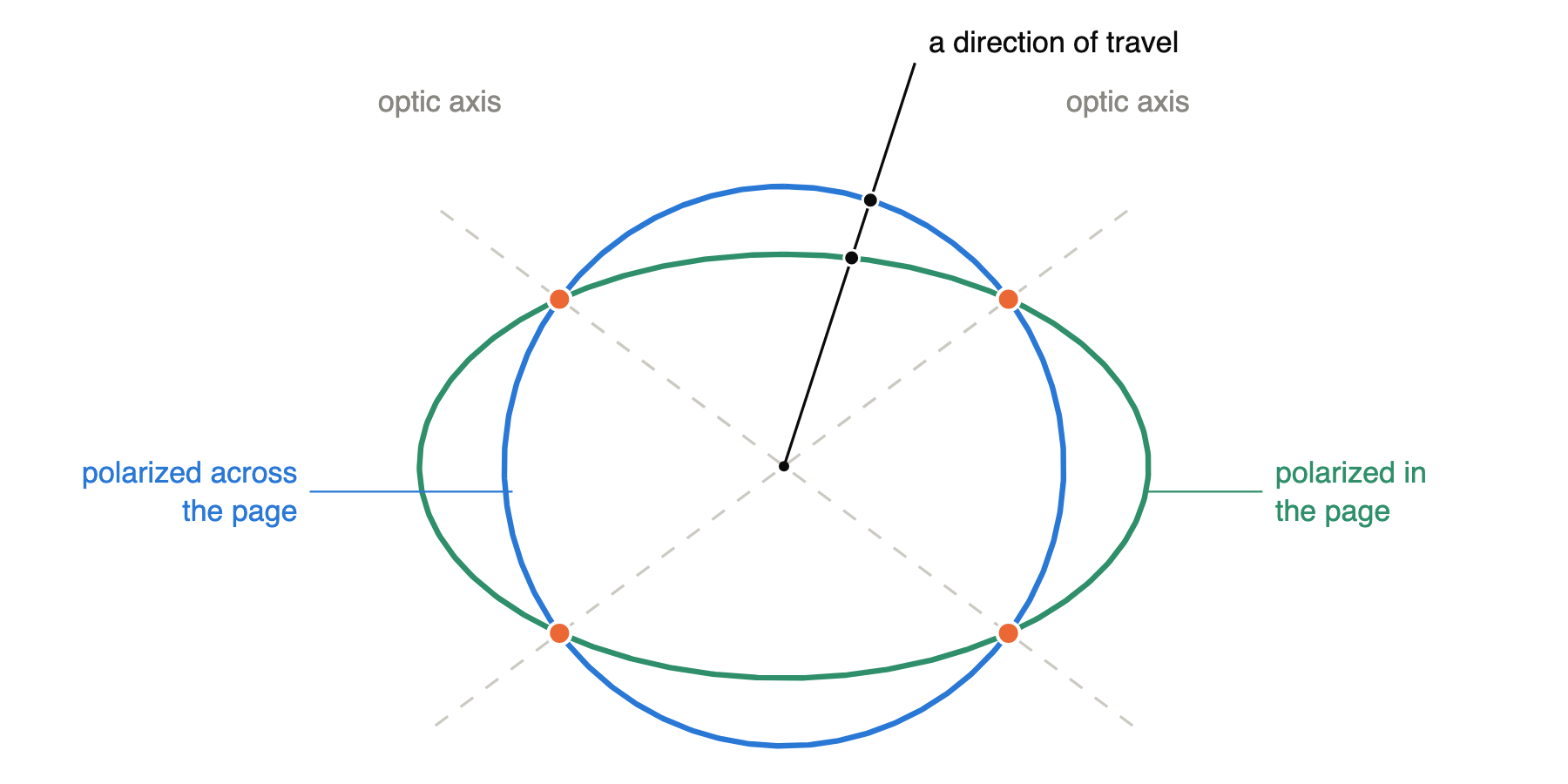
Away from this plane the two sheets never meet. The surface is two closed shells, one inside the other, that touch at exactly four points: two opposite pairs, along the two optic axes. David Brewster had found those directions by experiment in 1813, when he noticed that in topaz double refraction disappears along two particular lines. That is where the word biaxial comes from.
4. What the crystal cannot decide
Zoom in on one of the contact points and the two sheets turn out to be two cones standing tip to tip, like the juggler’s diabolo that gave Michael Berry his name for such a place: a diabolical point. Move away from the optic axis in any direction and the two speeds separate in proportion to how far you have moved — not gently, the way two surfaces grazing each other would, but with a corner.
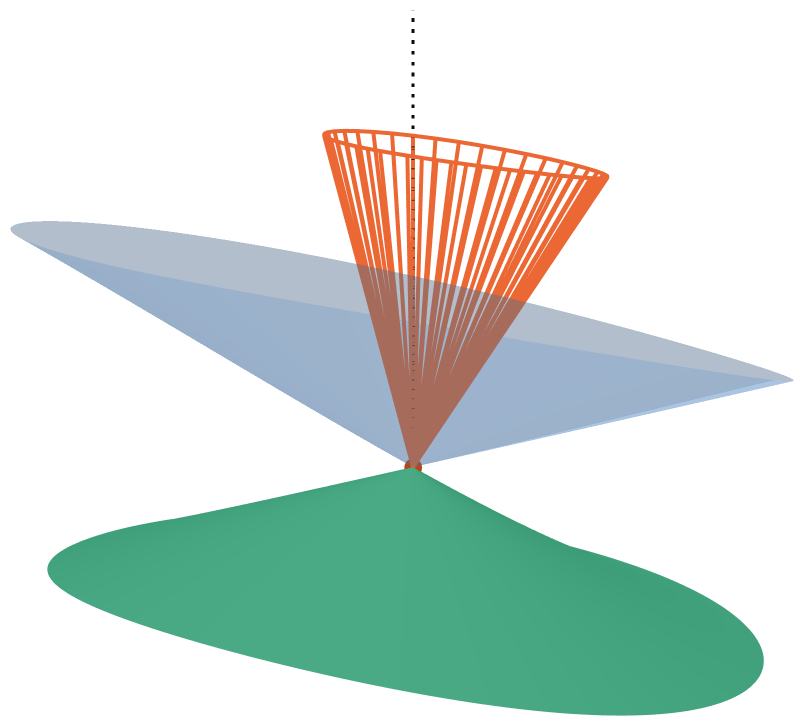
Why should the shape of the surface matter? Because of the one piece of physics this article takes on trust, which follows from Hamilton’s own theory of rays: the energy of a wave in a crystal does not in general travel along the wave’s own direction, but perpendicular to the index surface at that point. Figure 2 has already shown it happening. The second beam in calcite enters square-on and is pushed sideways, because the index surface underneath it is tilted.
At an ordinary point of the surface there is one tangent plane, one perpendicular to it, and so one ray. At the tip of a cone there is no tangent plane at all. Every straight line running up the side of the cone has one of its own, and each of their perpendiculars has an equal claim to be the direction of the ray. The wave travelling exactly along the optic axis cannot pick one. So it takes all of them: one wave, a whole cone of rays.
That is internal conical refraction, and the geometry of the cone is fixed by the crystal. The cone is slanted: one of its rays runs straight along the optic axis. Cut by a face square to the axis, it traces an exact circle through the point where the axis meets that face. And its opening — the angle \(2A\) between the optic axis and the opposite side of the cone — depends only on the three indices:
\[ \tan 2A \;=\; \sqrt{\frac{\left(n_2^{2}-n_1^{2}\right)\left(n_3^{2}-n_2^{2}\right)}{n_1^{2}\,n_3^{2}}} . \]For aragonite, \(A\) is almost exactly one degree. For naphthalene, the crystal C. V. Raman and his colleagues grew for their experiments of 1941, it is nearly seven times as much.
Then the light reaches the far face. Every ray in the cone belongs to the same wave, the one travelling along the optic axis, so every one of them is refracted back into the direction the light came in with. The hollow cone becomes a hollow cylinder, and a screen at any distance shows a ring whose radius is, very nearly, \(A\) times the length of the crystal. For an aragonite crystal twelve millimetres long, as Lloyd’s was, that is a ring 0.42 mm across: small, but unmistakable.
5. Half a turn
There is more to see. Lloyd found that the light in these cones is polarized — linearly, at every point — and that the direction of polarization changes as you go around. But it does not make one full turn as you go once around the ring. It makes half a turn.
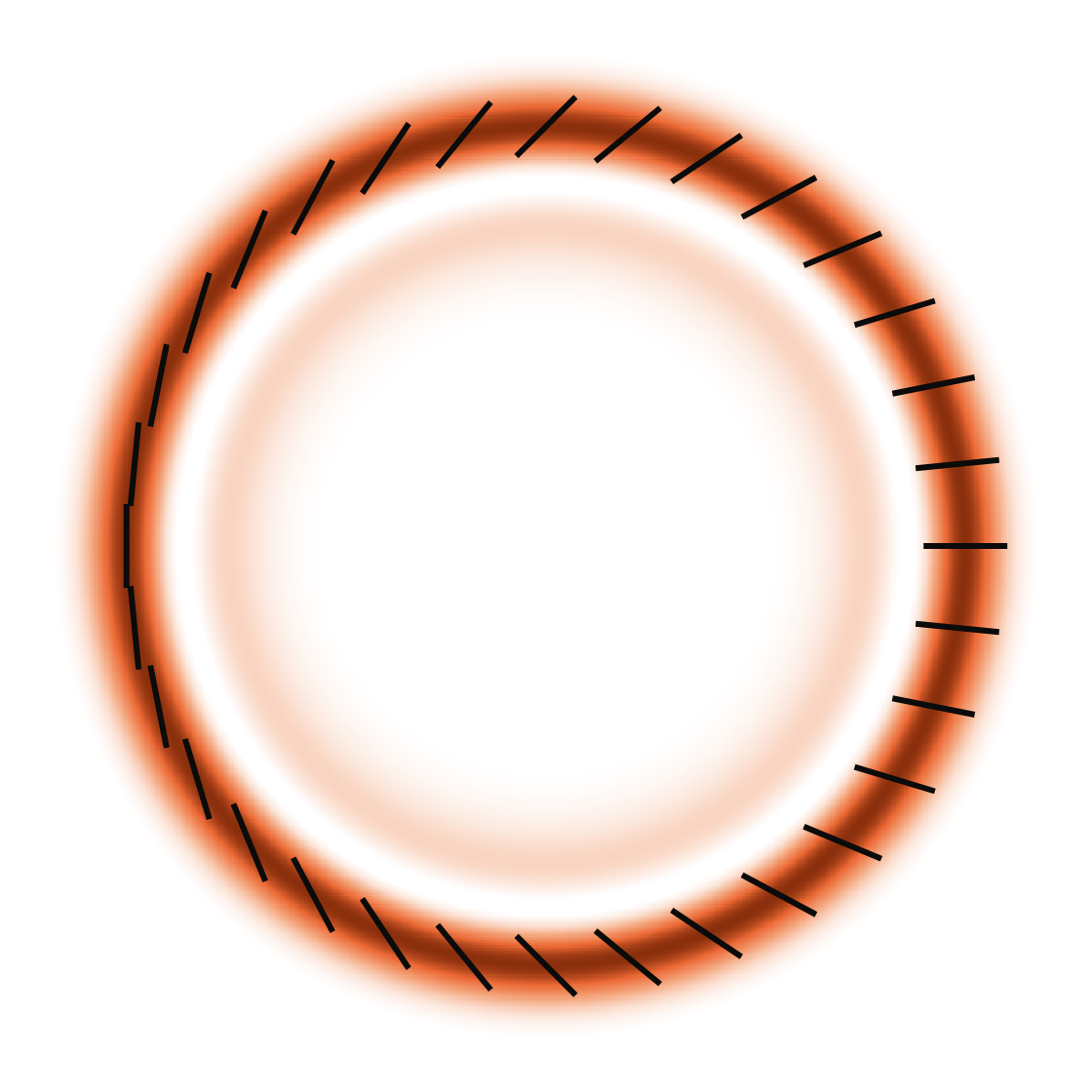

Seen from inside the crystal this is not mysterious at all, and it is the most important fact in the article. Each ray in the cone comes from a different side of the diabolo, and on each side the matrix \(M\) has its own pair of eigenvectors. Near an optic axis, and in suitable coordinates \((x, y)\) for how far the direction of travel is from the axis, the part of \(M\) that tells one polarization from the other is simply
\[ \begin{pmatrix} x & y \\ y & -x \end{pmatrix} \;=\; r \begin{pmatrix} \cos\phi & \sin\phi \\ \sin\phi & -\cos\phi \end{pmatrix} , \]with \(r\) and \(\phi\) the distance and the angle around the axis. Its eigenvalues are \(\pm r\), which grow in proportion to the distance: that is the cone of Figure 5. Its eigenvectors point at angles \(\phi/2\) and \(\phi/2 + 90^{\circ}\): that is the half turn. Walk once around the axis, \(\phi\) runs from \(0\) to \(360^{\circ}\), and the polarizations turn through \(180^{\circ}\). The cone and the half turn are one fact, seen twice.
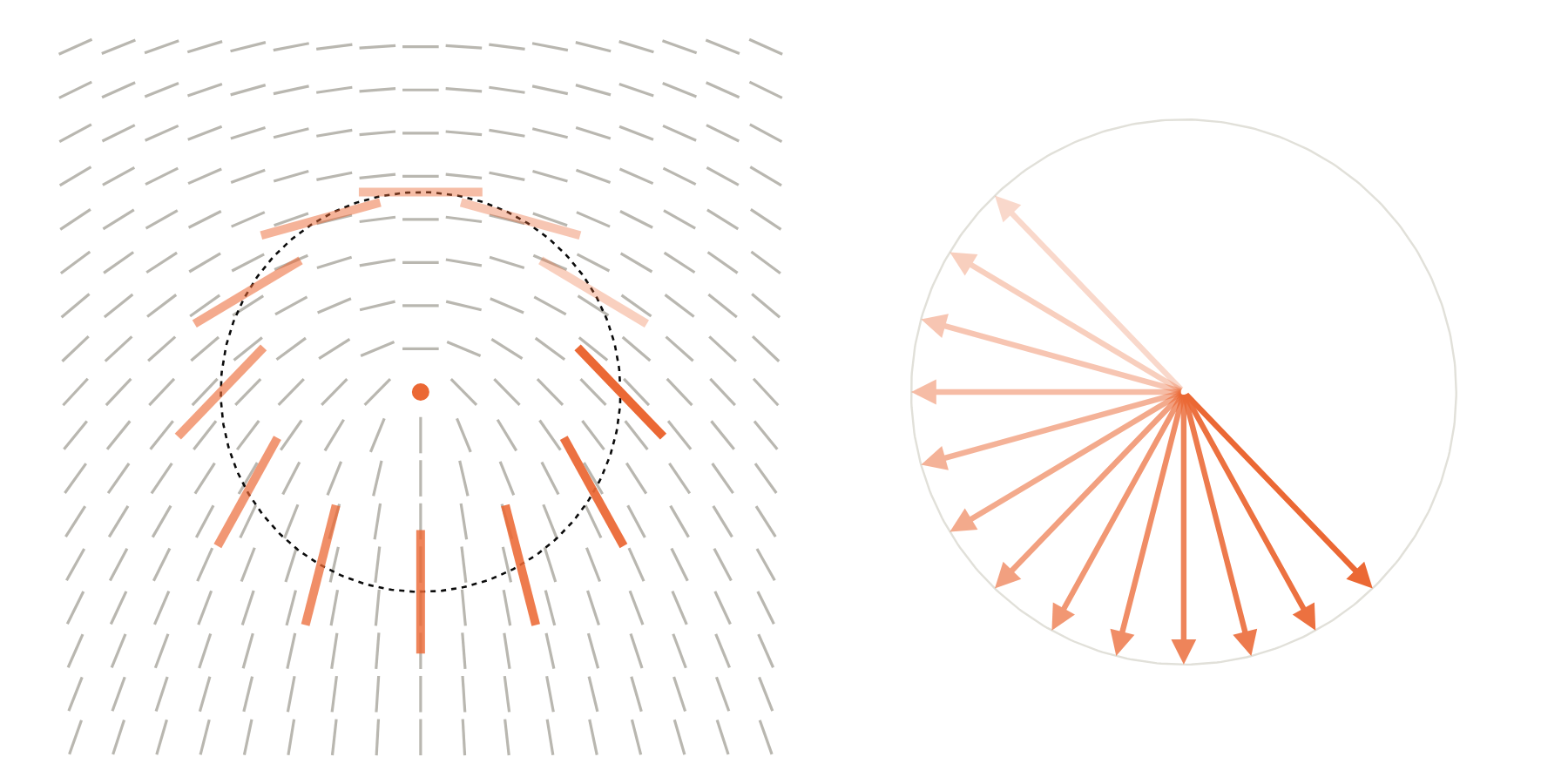
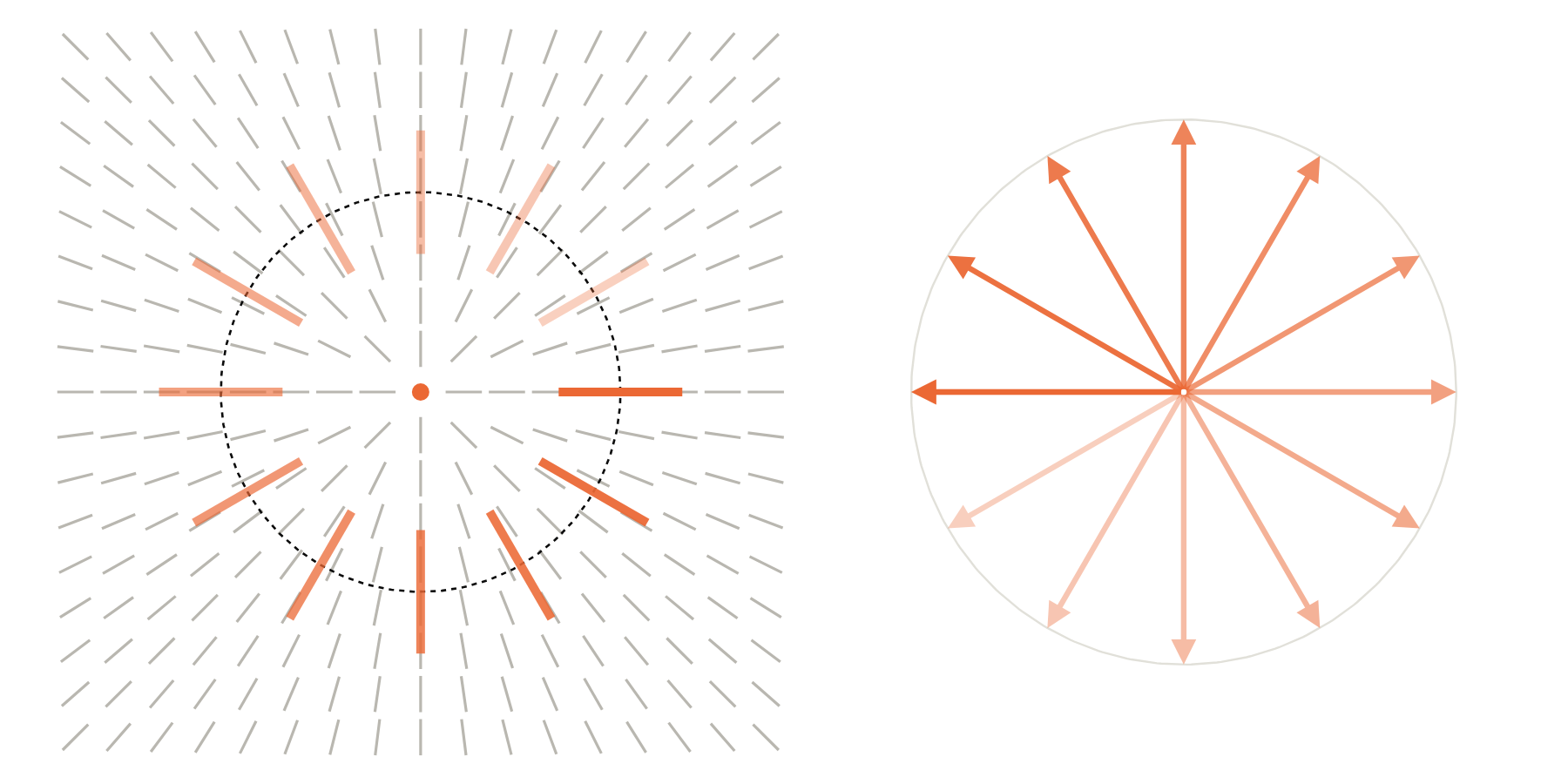
This is the same count as in Which Way Are You Facing?, applied not to a walker’s heading but to a field of lines. The number of turns the line makes on a small loop around a point is called the index of that point. For a field of arrows the index has to be a whole number, because an arrow must come back pointing the way it started. A line only has to come back to itself, so its index can be a half.
6. Why there have to be four
Now step back from any one axis and look at every direction at once. At each point of the sphere of directions of travel, the crystal specifies a line: the polarization of, say, the faster wave. That is a field of lines on a sphere, and it can be drawn.
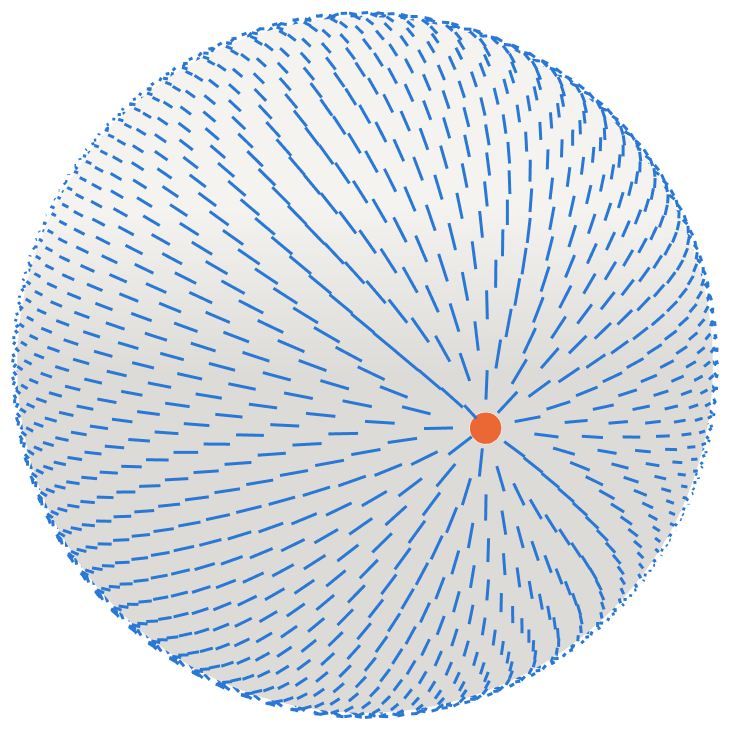
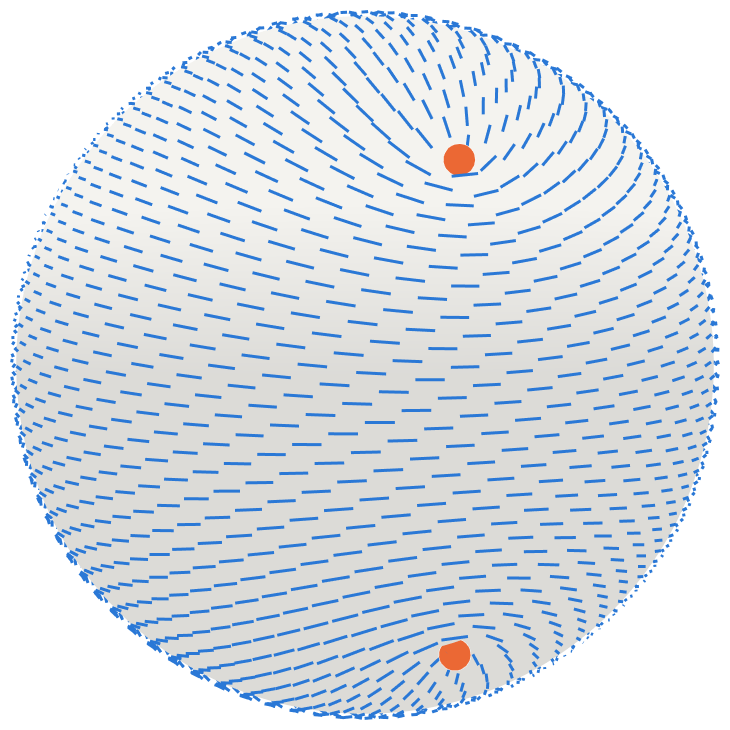
They have to. The Poincaré–Hopf theorem, extended to fields of lines, says that however such a field is drawn on a sphere, the indices of its singular points add up to 2 — the Euler characteristic of the sphere. The hairy ball theorem, which turned up in The Shape of All Possible Orientations, is the special case that there must be at least one. And a singular point of the polarization field is not a technicality. It is a direction in which the crystal prefers no polarization over any other, which means its two waves have the same speed. So every crystal that splits light at all — setting aside, for a moment, crystals that twist it — has optic axes. It cannot not have them, any more than a hairy ball can be combed flat.
How the bill of 2 gets paid is a matter of symmetry. A uniaxial crystal, such as calcite or sapphire, has two equal indices and pays with a single optic axis: two opposite points, each of index 1. At those points the two sheets merely graze each other, so there is no cone and no ring. But paying that way requires two indices to be exactly equal, and it is fragile. A place where the two eigenvalues of a real symmetric \(2 \times 2\) matrix meet takes two conditions — the diagonal entries equal, the off-diagonal entry zero — and so, among the two dimensions of directions on a sphere, such places are isolated points; at a typical one the matrix looks like the one in Section 5, the eigenvectors turn by half a turn, and the index is \(\pm\tfrac{1}{2}\). Make a uniaxial crystal’s two equal indices very slightly unequal and its single axis comes apart into two, a small angle apart.
So a crystal with three different indices must pay 2 in halves, and needs at least four such points; since light going backwards along a line meets the same two speeds, they come in opposite pairs. Four is exactly what every biaxial crystal has. The minimum that topology allows is precisely what nature does, and at each of those points the sheets meet in a cone, because that is what a half-turn meeting looks like. The cone Hamilton found by examining Fresnel’s surface was, in this sense, forced.
Nothing in this argument used much about light. It needed only that each direction of travel comes with a real symmetric matrix whose eigenvectors are lines across that direction. Asking the same question of other wave equations — elastic waves in a crystal, which have three sheets rather than two, or waves travelling on a curved surface rather than through flat space — and letting topology count the singular points that must appear is an active line of work.
7. What Hamilton could not see
Hamilton’s ring is geometry: a single ray, infinitely thin, and a cone with no thickness. Light does not come in single rays, and the difference is instructive. In 1839 Johann Poggendorff looked at the ring more carefully and reported a coal-black line running through it, and later observers confirmed what he had seen: the bright ring is really two, with a dark ring between them. In 1905 Voigt explained why, by way of a paradox. The light in Hamilton’s cone comes from a single point of the index surface, and a single point has no area; so the ray exactly along the axis, the one the whole cone was built from, carries no light at all. What a real beam contains is a small spread of directions around the axis, and each of those is ordinarily doubly refracted: two rays, one landing just outside Hamilton’s circle and one just inside. Hamilton’s ring marks, roughly, where the light is not.
The modern theory, due to A. M. Belsky and A. P. Khapalyuk in 1978 and put in its cleanest form by Berry in 2004, is wave optics rather than ray optics, and it is remarkably compact. For a round beam sent along the optic axis, with \(a(\kappa)\) saying how much of it travels at each small angle \(\kappa\) to the axis, the whole pattern behind the crystal is built from two integrals:
\[ b_{\pm}(\rho, \zeta) \;=\; \int_{0}^{\infty} \kappa\, a(\kappa)\, e^{-i\zeta\kappa^{2}/2} \Big[\, J_0(\kappa\rho)\cos\kappa\rho_0 \;\pm\; J_1(\kappa\rho)\sin\kappa\rho_0 \Big]\,\mathrm{d}\kappa . \]Here \(\rho\) is the distance from the centre of the ring and \(\zeta\) the distance from the plane in which it is sharpest, both in units set by the beam, and \(J_0\) and \(J_1\) are Bessel functions. Light polarized along the ring’s own half-angle direction has amplitude \(b_+\); light polarized across it, \(b_-\). And everything about the crystal and the beam is folded into one number, \(\rho_0\): the radius of Hamilton’s ring divided by the width of the beam.



Away from that plane the two rings go separate ways, which Richard Potter noticed in 1841 and Raman photographed a century later. The outer ring spreads and fades. The inner one closes in on the centre until it has become a bright spike.



8. Try it
Every figure here comes from the small matrix of Section 2. In code it is a handful of lines: build the crystal’s response along its own axes, restrict it to the plane across the direction of travel, and ask for eigenvalues and eigenvectors.
def waves(n, s):
    """The two plane waves a crystal allows along the direction s."""
    eta = np.diag(1 / np.square(n))        # the crystal, along its own axes
    u, v = across(s)                       # any two unit vectors across s
    M = np.array([[u @ eta @ u, u @ eta @ v],
                  [v @ eta @ u, v @ eta @ v]])
    inv_n2, d = np.linalg.eigh(M)          # the eigenvalues are 1/n^2
    return 1 / np.sqrt(inv_n2), d.T @ [u, v]    # slow wave first
Ask it about a direction along an optic axis and the two indices come back equal. Walk a small circle of directions around that axis, follow either polarization continuously, and it comes back reversed: half a turn. Walk around any other direction and it comes back exactly where it started.
The accompanying tests check what can be checked. That both indices satisfy Fresnel’s equation for the index surface in five thousand random directions, and that the lines above agree with the library that drew the figures; that a brute-force search of the sphere finds exactly four contact points for aragonite, for naphthalene and for the exaggerated crystal of the figures, and exactly two for a uniaxial one, all on the closed-form optic axes; that the gap between the sheets grows linearly away from a biaxial contact and quadratically away from a uniaxial one, and that a uniaxial axis splits in two when its equal indices are separated; that the rays at a contact point form a cone that contains the optic axis, opens to exactly \(2A\), and lands on a circle, to within rounding error, on a face cut square to the axis; that every biaxial contact has index ½ and every uniaxial one index 1, adding up to 2 either way; that with optical activity switched on the speeds never meet but the half turn survives; and that the wave theory loses no light, hands back the incoming beam unchanged when the cone has no width, puts the polarization at exactly half the azimuth, and places the rings and the spike where the captions say they are.
What stays with me is that the prediction came from asking a surface a question it could not answer. At an ordinary point the index surface says which way the light goes; at four points it has no opinion, and Hamilton had the nerve to take the absence of an answer literally and predict every answer at once. Nor are those four points an accident of aragonite. A field of lines on a sphere has to break somewhere; where it breaks, a crystal’s two speeds must coincide; and where two speeds coincide with no special symmetry to help them, they meet in a cone and the lines turn by a half. Hamilton found the cone by looking at a surface. He could have found it by counting.
Further reading
- W. R. Hamilton, Third supplement to an essay on the theory of systems of rays, Transactions of the Royal Irish Academy 17 (1837) 1–144 — the prediction, presented to the Academy in 1832.
- H. Lloyd, On the phenomena presented by light in its passage along the axes of biaxial crystals, Transactions of the Royal Irish Academy 17 (1837) 145–158 — the observation, and the half turn of the polarization.
- A. M. Belsky and A. P. Khapalyuk, Internal conical refraction of bounded light beams in biaxial crystals, Optics and Spectroscopy 44 (1978) 436–439, and M. V. Berry, Conical diffraction asymptotics: fine structure of Poggendorff rings and axial spike, Journal of Optics A 6 (2004) 289–300 — the two integrals of Section 7, and what they contain.
- M. V. Berry and M. R. Jeffrey, Conical diffraction: Hamilton’s diabolical point at the heart of crystal optics, Progress in Optics 50 (2007) 13–50 — the best single account, history included.
- C. Valero, Maxwell’s equations, the Euler index, and Morse theory, Mathematical Notes 100 (2016) 352–362, arXiv:1311.0569, and C. Valero-Valdés, Singular geometrical optics for differential operators on surfaces, Journal of Mathematical Physics 62, 021508 (2021), doi:10.1063/5.0028955 — the singular points of the Fresnel surface accounted for by topology alone, and the same question asked of wave equations on surfaces.
I work as an independent consultant helping engineering and computational teams solve difficult problems in geometric modeling, surface processing, and algorithmic design. If your team is tackling a non-trivial spatial or mathematical challenge, reach out directly at cvalero@carlosvalero.com.