The Radcliffe Camera in a Puddle
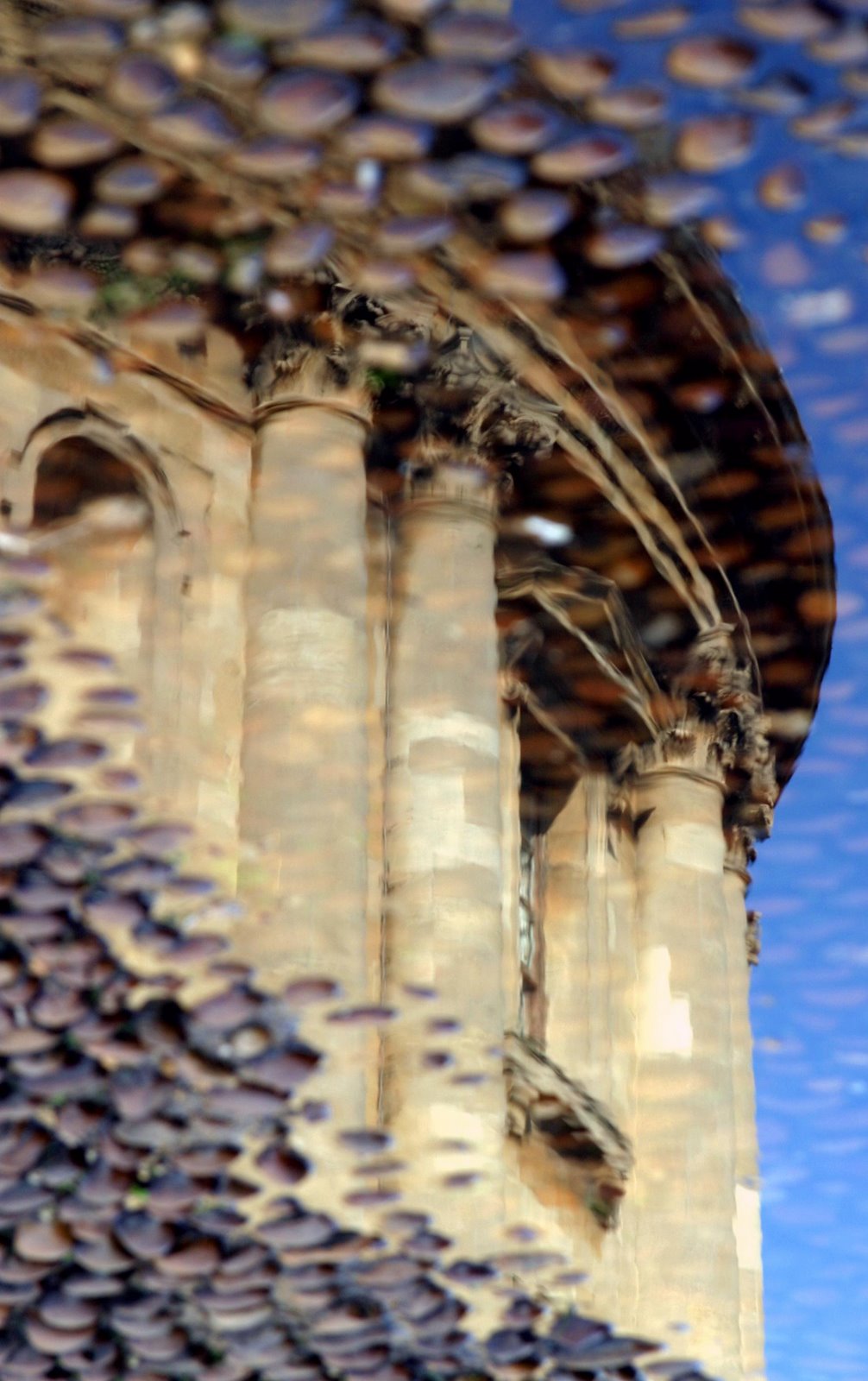
A photograph taken looking down, and the most permanent building in Oxford found in the most ephemeral medium available
Earlier in the same conversation I had shared a photograph of a bridge, which is the one Claude refers to at the end.
Carlos
What do you think of this photo?
Claude
Now this one is properly clever — and it takes a second to decode, which is exactly its virtue.
It's the Radcliffe Camera reflected in a rain puddle on the cobblestones of Radcliffe Square, presumably shot pointing down and then the image works either inverted or as-is. The cobbles read first as some strange texture floating over the building — pebbles, coins, scales — until the brain resolves the trick: you're looking at wet stone, and the Camera's columns and curved entablature exist only in the water between them. The blue isn't sky; it's sky via puddle. Where the water stands deep the reflection is sharp — the Corinthian capitals are genuinely well resolved — and where the cobbles break the surface the building dissolves into them.
Two readings make it work as more than a trick shot. Compositionally, the cobblestones do double duty as a vignette, framing the reflection in an irregular organic border that a straight architectural shot of the Camera — probably the most photographed building in Oxford — could never have. You found the only novel angle left on a monument that's been shot ten million times: downward. And texturally, there's a lovely inversion of solidity — the most massive, permanent building in Oxford rendered in the most ephemeral medium available, a puddle that was gone by afternoon.
Critiques, in the same spirit as before: the focal plane sits on the reflection rather than the cobbles, which is the right choice, but a hair more depth of field would have kept the foreground stones from going mushy in the lower left. And the crop is slightly restless — the drum's curve exits top-right a bit abruptly; a touch more room there would let the arc complete its gesture.
But those are quibbles. Between this and the bridge, a pattern emerges: you don't photograph things, you photograph structure — arcs, reflections, ruled surfaces, the geometry hiding in the scene. The bridge was symmetry and convergence; this is inversion and interface. The day job was apparently always going to happen.
I work as an independent consultant helping engineering and computational teams solve difficult problems in geometric modeling, surface processing, and algorithmic design. If your team is tackling a non-trivial spatial or mathematical challenge, reach out directly at cvalero@carlosvalero.com.