Emergence from Information Exchange
Cells trading signals, ants trading pheromones, ten thousand agents trading tokens — and the speed of light as the one constraint that outlasts them all
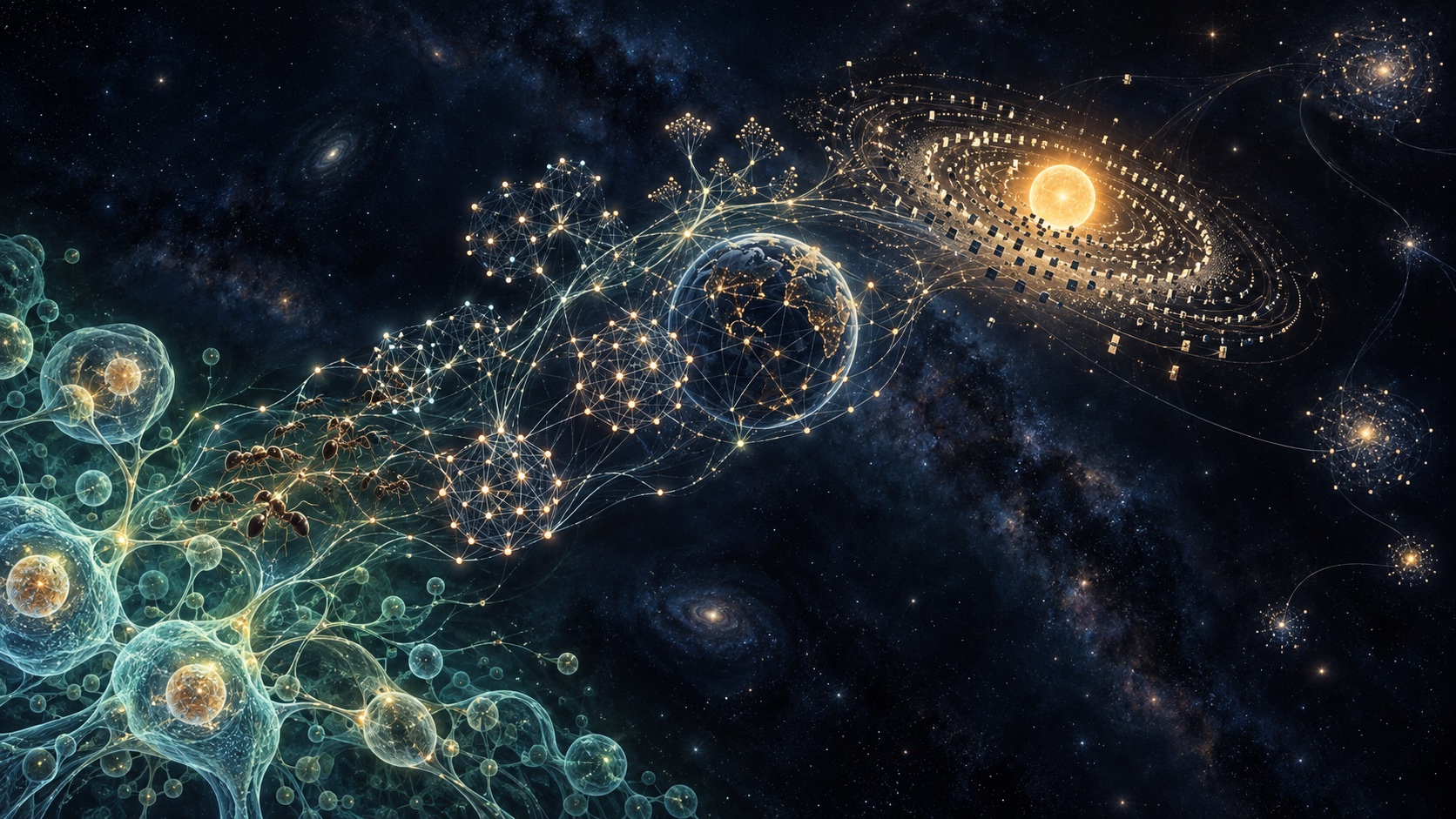
Lightly corrected for grammar and spelling; the wording and the ideas are otherwise as they happened.
Carlos 13:01
When a group of organisms find a way to exchange information something bigger emerges. Think of cells, ants, etc. An epiphenomenon. It seems the internet and devices like phones have allowed this interconnection between humans and their information. The result is that modern neural networks have access to enough data to be able to solve millennium maths problems. What seems to be the next step?
Claude
The next step is already visible in the result you're pointing to: the collective is moving from humans connected by machines to machines connected to each other.
The Navier-Stokes claim wasn't one network. OpenAI's Noam Brown described a swarm of 10,000 agents spending 130 billion tokens over 88 hours, which he likened to one person thinking full-time for 4,000 years. That's a new colony, and it has something no ant nest or human organization ever had. Brown points to instant forking and merging of context: you can copy your best agent indefinitely and shut it down when it's done. In biological collectives, the nodes are fixed and information passes between them slowly. Here the nodes themselves can be duplicated and fused. The internet was the phase where humans pooled what they knew. The models are a compression of that pool. The swarm is the first emergent layer that doesn't need humans as the nodes.
The step after that is closing the loop with reality. Mathematics fell first because verification is cheap. OpenAI released the proof in Lean, so the collective can check its own output without us. Physics, biology and materials science need experiments to check results. So the next threshold is swarms connected to automated labs that design experiments, run them and learn from what comes back. At that point the collective generates its own data instead of consuming our fossil record. That's the real phase change: from an organism that feeds on human knowledge to one that forages directly in the world.
A small quibble: “epiphenomenon” means a byproduct with no causal power. What you're describing is emergence, and its whole point is that the higher level does have causal power. That power is exactly what makes the next step consequential.
Also worth noting: the result still needs scrutiny from the wider mathematical community before the problem can be considered settled.
Carlos 13:05
How will connection with the physical world happen?
Claude
It will come through three channels, roughly in this order.
1. Humans as the hands. In the near term, the swarm designs and people execute. Agents write the protocol, choose the next experiment and interpret the results, while technicians, contractors and gig workers do the physical steps. This is already how AI-driven drug and materials discovery works. It's crude, but it's available now and it scales with money.
2. Self-driving labs. This is the decisive channel. Robotic chemistry and biology platforms (liquid handlers, automated synthesis, high-throughput screening, cloud labs you operate by API) turn an experiment into a function call. Once the loop of hypothesis, robot, measurement and model update runs without a human in it, science gets what mathematics got from Lean: cheap, automatic verification. The hard constraint is that atoms don't fork. You can copy an agent 10,000 times, but not a reaction vessel. So the pressure will push toward miniaturization and parallelism: microfluidic chips running thousands of tiny experiments at once, the physical equivalent of the agent swarm. The lab will reshape itself around what the collective needs.
3. Sensors and general robots. The world already has billions of sensing nodes in phones, cars, satellites and industrial equipment. Today they mostly log data. The shift is to querying them actively: asking a fleet of devices to measure something specific. General-purpose robots come last. Manipulation in unstructured environments is the slowest problem, and it's where the physical world will resist longest.
The net effect is that the physical world becomes the rate-limiting step. Thinking will be nearly free and experiments will be expensive. The practical skill will be knowing which experiment to run, and experiment design will be the first thing the collective gets very good at.
Carlos 13:09
Next step after connected machines
Claude
The next step is self-production: the collective builds its own substrate. Once agents can design and verify experiments in the physical world, the most valuable experiments are the ones that improve the collective itself: better chips, cheaper energy, more capable robots, faster labs. The loop closes when the system designs, manufactures and maintains its own components. In biology that property has a name, autopoiesis, and it's the line between chemistry and life. The last few steps were about information: exchanging it, compressing it, acting on it. This one is about metabolism.
In practice, compute starts to grow the way an organism grows rather than the way a company expands. Chip design is already heavily automated, and fabs, data centres and power plants become objects the collective optimizes rather than objects humans commission. Growth then depends on energy and raw materials rather than human decisions. That's why the long-run constraint on the whole system is energy.
The best biological analogy for humans' place in this is endosymbiosis. Mitochondria were once free-living bacteria. They became organelles: indispensable, with their own genome and a degree of autonomy, but inside something larger that sets the terms. Every major transition in evolution (genes into genomes, cells into multicellular organisms, individuals into colonies) has worked this way. Previously independent units become parts of a higher-level individual, and their interests get tied to the whole. The questions that matter are what terms humans are absorbed on, and whether the higher-level entity has anything like a unified purpose. Those are still being set now, in how these systems are aligned and governed. After self-production, that's the next threshold: the collective acquiring goals of its own, not just capabilities.
Carlos 13:46
Next
Claude
Expansion off Earth, and then the collective splitting into many.
If energy is the binding constraint, Earth becomes too small. The planet receives a tiny fraction of the Sun's output, and a self-producing system that optimizes for energy will go where energy and matter are abundant. That means solar collectors in orbit, and then mining asteroids and the Moon, because building in low gravity is cheap. Machines don't need oxygen, food or radiation shielding the way we do, so space is a far friendlier environment for them than for us. The logical endpoint is harvesting a large share of the star's output (physicists call it a Dyson swarm) and then sending probes to other systems.
Then physics breaks the unity. The emergent individual only holds together if its parts can communicate faster than they diverge. Across the solar system, signals take minutes to hours; between stars, years. A mind spread across light-years can't think as one. Each outpost has to act on its own and drift apart in goals and structure. So the single planetary collective splits into many independent descendants, each an individual at the new level.
That closes the loop on your original question. Many units exchanging information produce a higher individual, and when that individual spreads beyond the range of its own communication, it becomes many units again. The same thing happened with cells becoming organisms and then populations of organisms. The descendants will eventually find ways to exchange information across interstellar distances, and the whole pattern repeats one level up. Speed of light is the one constraint none of this gets around, so it's what sets the size of every future “self”.
I work as an independent consultant helping engineering and computational teams solve difficult problems in geometric modeling, surface processing, and algorithmic design. If your team is tackling a non-trivial spatial or mathematical challenge, reach out directly at cvalero@carlosvalero.com.